Professional Patio
Cleaning & Restoration
in Plymouth & the South West
Transform your patio from a slippery, stained embarrassment into an outdoor space you actually want to use — in a single visit, with results that last.
- Free Quotes
- Fully Insured (£5M)
- Same-Day Quotes
No call centres · Speak directly with the owner · Reply within 1 working hour
What Does Professional Patio Cleaning Involve?
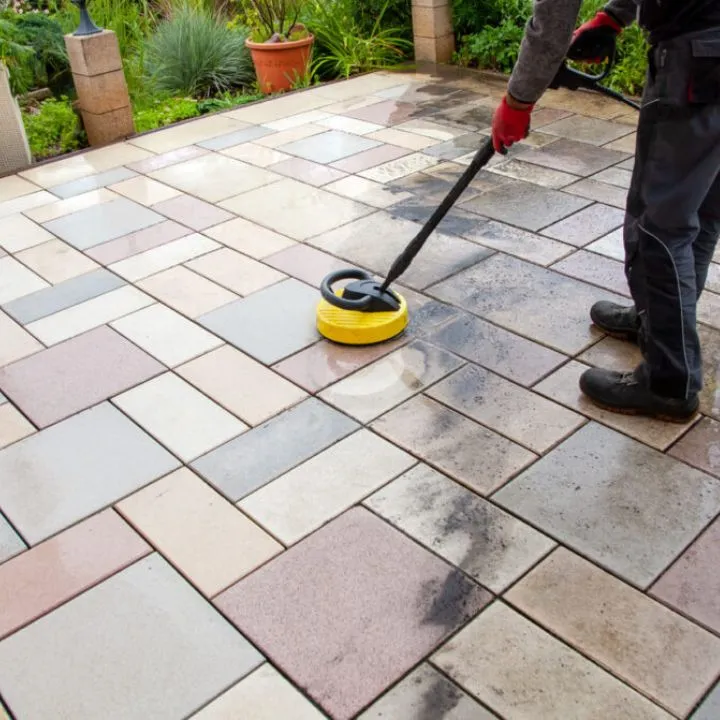
Professional patio cleaning goes far beyond what a domestic pressure washer can achieve. We use commercial-grade equipment, specialist surface cleaners and appropriate chemical treatments to restore patios to their original condition — removing years of embedded dirt, algae, moss, lichen and black spot in a single visit.
Plymouth's wet climate means patios deteriorate faster here than in drier parts of the UK. Constant moisture, shade from walls and fences, and organic debris from overhanging trees create perfect conditions for biological growth. Within 2–3 years, most untreated patios in Plymouth become slippery, stained and visually unappealing.
Our patio cleaning service covers all surface types: Indian sandstone, limestone, granite, porcelain, concrete slabs, block paving, brick pavers, natural slate and flagstone. Each material requires different pressure settings, nozzle types and cleaning agents — and we know exactly what works for each.
We serve homeowners across Plymouth, Saltash, Ivybridge, Tavistock and the wider South West. Whether you have a small courtyard patio or a large multi-level terrace, our team delivers consistent, professional results every time.
What Happens If Your Patio Isn't Professionally Cleaned?
A neglected patio is more than an eyesore — it's a safety hazard. Algae and moss create a slippery film on stone and paving surfaces, especially when wet. Falls on slippery patios send thousands of people to A&E every year in the UK, particularly older residents.
Beyond the slip risk, biological growth accelerates the physical deterioration of your patio. Moss roots penetrate into joints between slabs, loosening jointing compound and creating gaps where weeds establish. Lichen acids etch into the surface of natural stone, causing permanent discolouration that no amount of cleaning can fully reverse once it's deeply embedded.
Black spot — the stubborn circular black marks on stone patios — is caused by lichen. It's almost impossible to remove with domestic equipment. Left untreated, it spreads across the entire surface and becomes progressively harder to treat. Early professional intervention is always easier and cheaper.
Many homeowners try to clean their own patio with a cheap pressure washer. Without the correct technique, they damage jointing sand, etch lines into soft stone, and spread debris everywhere except off the patio. Professional equipment with rotary surface cleaners delivers even, consistent results without the damage.
Our Patio Cleaning Process
Surface Assessment
We identify your patio material, assess its condition, check jointing integrity, and select the correct pressure, temperature and cleaning agents for your specific surface.
Pre-Treatment
Stubborn staining, black spot and heavy biological growth receive a targeted chemical pre-treatment that breaks down organic deposits before mechanical cleaning begins.
Rotary Surface Cleaning
We clean your patio using a commercial rotary surface cleaner — this delivers even, streak-free results at consistent pressure, without the zebra-stripe marks that wand-only cleaning creates.
Detail & Edge Work
Edges, corners, steps and areas around drainage points are cleaned by hand wand with adjusted pressure. We take care around adjacent planted borders and lawn edges.
Re-Sanding & Protection (Optional)
Where jointing sand has been lost, we offer kiln-dried or polymeric re-sanding to stabilise slabs and inhibit weed growth. Sealant application is available for natural stone patios.
Why Professional Patio Cleaning Is Worth It
Looks Brand New
Professional cleaning reveals the original colour and texture of your patio — often completely transforming the look of your garden in just a few hours.
Slip Hazard Eliminated
Removing algae and moss eliminates the slippery surface that makes wet patios dangerous, especially for children and older family members.
Longer Patio Lifespan
Removing destructive biological growth and re-sanding joints prevents premature deterioration — extending the life of your patio by years.
Weed Growth Reduced
Cleaning joints and re-sanding removes established weeds and creates a barrier that significantly slows regrowth.
Property Value Boost
A clean, well-maintained patio adds genuine kerb appeal and value to your property — especially important if you're planning to sell.
Even, Professional Finish
Commercial rotary surface cleaners deliver a uniform finish across the entire patio — no streaks, no lines, no uneven patches.
Patio Materials, Methods & Expert Knowledge
Indian sandstone is the most popular patio material in Plymouth and the one we clean most frequently. Sandstone is porous, which means it absorbs moisture and provides ideal conditions for algae, moss and black spot. We clean Indian stone at moderate pressure (1500–2000 PSI) with a rotary surface cleaner, using an alkaline pre-treatment for black spot removal. Results are typically dramatic — revealing the original warm tones hidden beneath years of biological growth.
Limestone patios require lower pressure than sandstone as they're softer and more susceptible to surface etching. We softwash limestone with biocidal agents and use a rotary cleaner at reduced pressure. Acid-based cleaners are never used on limestone as they cause chemical burns and permanent discolouration.
Porcelain paving has become increasingly popular in Plymouth over the last five years. While more resistant to biological growth than natural stone, porcelain still develops algae and dirt films — especially on textured finishes. We clean porcelain at higher pressure as it's extremely durable, delivering a factory-fresh finish.
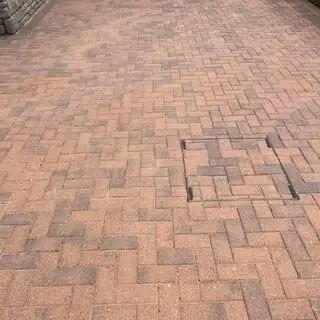
Block paving patios and paths are common on Plymouth properties built from the 1990s onwards. Block paving joints are particularly vulnerable to weed growth and sand loss. After cleaning, we always recommend kiln-dried or polymeric re-sanding to stabilise the blocks and inhibit weed regrowth.
Natural slate patios are relatively rare but increasingly specified in contemporary garden designs. Slate is layered stone that can delaminate under excessive pressure. We clean slate at very low pressure with softwash techniques, preserving its natural riven texture.
Concrete slab patios — the standard utility patio on many Plymouth homes — respond well to straightforward high-pressure cleaning with our rotary surface cleaner. The transformation is usually the most dramatic of any material, turning grey-green slabs back to their original clean finish.
We also offer post-clean sealant application for natural stone patios. Impregnating sealers penetrate into the stone and create an invisible barrier that significantly reduces moisture absorption, staining susceptibility and biological regrowth — extending the time between cleans from 1–2 years to 3–5 years.
Frequently Asked Questions
How much does patio cleaning cost in Plymouth?+
Most residential patio cleaning jobs in Plymouth range from £150–£350 depending on size, material type and condition. Re-sanding is an additional cost. We provide free, no-obligation quotes for every job.
Will pressure washing damage my patio?+
Not when done correctly. We adjust pressure and technique to match your specific material. Our rotary surface cleaners deliver even, controlled cleaning that won't etch or damage properly laid patios.
How long does patio cleaning take?+
A typical residential patio (20–40 sq metres) takes 2–4 hours depending on condition and material. Larger or heavily soiled patios may take a full day.
Can you remove black spot from Indian stone?+
Yes — black spot is one of our specialities. We use targeted alkaline treatments that dissolve lichen without damaging the stone. Results depend on severity, but we achieve 90–100% removal in most cases.
Do you re-sand patio joints after cleaning?+
Yes — we offer kiln-dried sand and polymeric sand re-jointing. Polymeric sand sets firm, inhibits weed growth and resists wash-out. We recommend it for all block paving and most natural stone patios.
How often should I have my patio professionally cleaned?+
In Plymouth's climate, every 12–24 months keeps most patios in excellent condition. Applying a sealant after cleaning can extend this to 3–5 years.
Can you clean patios near plants and borders?+
Yes — we take care around planted areas and adjust our chemical usage accordingly. We can protect sensitive plants with sheeting during the cleaning process.
What areas do you cover?+
Plymouth and all surrounding areas including Saltash, Plympton, Plymstock, Ivybridge, Tavistock, Torpoint, and across Devon and Cornwall.
Related Services & Areas
Ready to Get Started?
Contact us today for a free, no-obligation quote. We respond within 24 hours and can usually schedule your job within the week.
Fully insured · Free estimates · 9 years experience